
The Old Spaulding School: Transforming Barre's landmark school into the Vermont History Center
By Nate Youmans, VHS Intern
Tucked between agrarian fields and green mountains, the city of Barre is literally and figuratively built on granite. Since its charter as part of New Hampshire in 1780, Barre has been a melting pot of Yankee traditions and the customs of over sixteen distinct immigrant populations. By the 1880s, the city was growing the fastest of all of Vermont’s townships, exploding from a thousand to six thousand residents, with more than a third of those residents working in the quarries or granite sheds.
This working-class boom led to the construction of over 600 homes and a rapid expansion of public infrastructure and transportation, and the founding of the single-classroom Barre Academy in 1852, led by Principal Jacob Spaulding. At the time, Vermont’s education system was guided by a 1797 statute which allowed each town to create and divide its own school districts. This approach, combined with rising operational costs and small student populations, led to the creation of 2,591 individual school districts spread out across 294 towns – an average of more than eight districts per town.
Vermont’s educational system remained disorganized and inefficient until state legislators passed a law to fund schools through one of the nation’s first statewide property taxes in 1890. With increased funding and new legislation aimed at improving consistency and quality, Barre Academy soon rivaled similar institutions such as Holyoke, but the growing population of the city quickly outpaced its capacity. Following the death of Principal Spaulding in May 1880, the school fell into financial issues and closed in 1885.
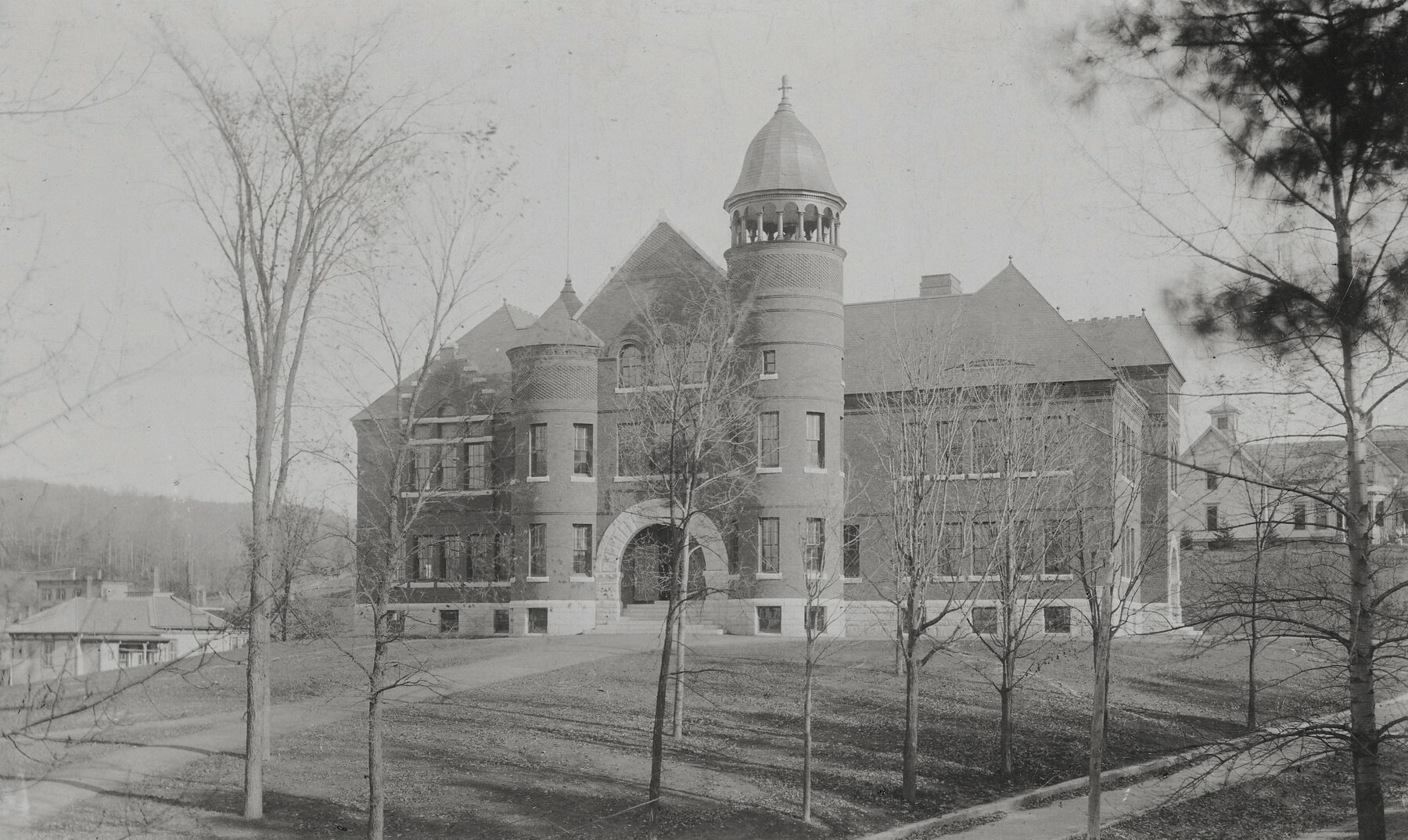
After months of planning and negotiation, the state approved Act 258 on November 28th, 1888; its trustees transferred the property to the city for the purpose of constructing a new school. The city commissioned architect Lambert Packard of St. Johnsbury to design a new school that would serve as a symbol of both Barre’s progress and Vermont’s commitment to public education. This new school building was named for Spaulding, and on August 15th, 1891, workers laid the first cornerstone. On September 2nd, 1892, it was dedicated and opened.
Barre’s Granite City Leader reported that more than a thousand residents showed up to inspect the school, and in his opening remarks, State Superintendent Edward F. Palmer said “Children are the heralds of the future,” and that this new school would be “an enduring inspiration to learning to every boy and girl in Barre.”
When it opened, the new Spaulding school quickly reached capacity. To further accommodate the educational needs of Barre’s children, the city constructed several additional primary schools throughout the city over the next decade and transformed Spaulding into a high school. In 1914, the city constructed an addition to the structure, adding an auditorium, a gymnasium, and six additional classroom spaces to accommodate the growing student body, as well as a new heating and ventilation system.
The Spaulding High School served Barre through the next half-century from Washington Street. As Barre’s population continued to grow and as concerns over public education mounted, the city decided to construct a larger, modern facility. It acquired the old Trotting field on Ayers Street to construct the new Spaulding High School, and repurposed the old building to serve Barre’s 6th, 7th, and 8th grades.
By the time the Spaulding school building celebrated its centennial in 1991, Barre had to contend with the legacy of its expanding school districts. It maintained 5 aging elementary schools across the city, including the Spaulding building. It decided to consolidate, closing the neighborhood schools and opening the new Barre City Elementary and Middle School in 1995. For the first time in more than a century, the halls of the old Spaulding school were quiet.
In 1992, an ice jam flooded the streets of Montpelier and the then headquarters of the Vermont Historical Society. Faced with the prospect of future floods, VHS began to look for a new location, and in December 1996, began considering the now-vacant school building as a new home for its collections and library. In 2000, it purchased the structure and began an ambitious campaign to restore and renovate it, transforming it into the Vermont History Center.
The building houses archives, exhibitions, public programs, educational workshops, and cultural spaces. When it opened in 2002, the building housed the historical society’s administrative offices, library, museum collections, exhibition space, and meeting spaces for conferences, presentations, and workshops.
With its acquisition of the Spaulding School building, VHS has carefully maintained the building’s architectural integrity while reimagining its use to serve the public in new and engaging ways. Hallways once filled with the footsteps of students now welcome researchers, and visitors interested in exploring their shared past, fostering learning and connections across generations.
In this way, Spaulding endures not only as a monument to Barre’s industrious past, but also as a living institution where Vermont’s stories continue to unfold.
This article was in the 2025 Fall/Winter issue of History Connections, our member magazine. To get it, you can sign up as a member here.