Preserving Stories: an interview with VHS librarian Steve Picazio
By Emily Lev, VHS Director of Stewardship & Public Relations
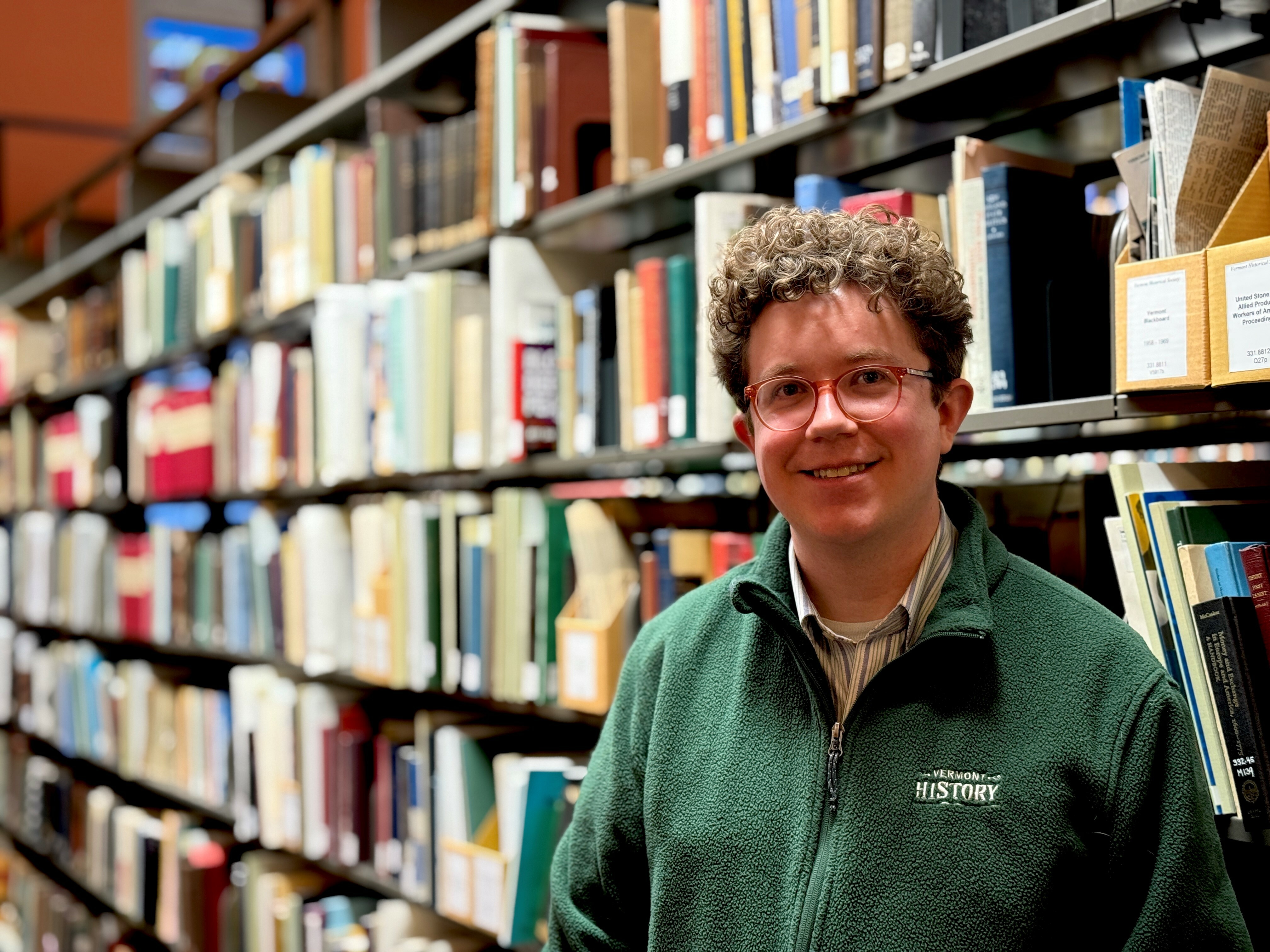
It’s a bright winter’s day at the Leahy Library in the Vermont History Center in Barre, where Steve Picazio, Vermont Historical Society’s librarian, is explaining the importance of acquiring, conserving, and sharing items in the VHS’s vast collections.
“One of the things that we’re constantly doing with all of our collections is asking where we have gaps when it comes to telling Vermont’s story,” says Picazio. “We want history from the major decision makers, but we also want the history of people living in Vermont.”
The VHS wants to include materials from a diverse range of voices, yet most of our acquisitions are donations. “In most cases we get cold calls from people who have uncovered or inherited pieces of paper,” explains Picazio. “They want to ensure that these documents are preserved and that their stories aren’t lost.” While the VHS is grateful for donors who choose to entrust these treasures to our care, this method of acquisition can leave gaps in the story of Vermont that is told by our collections.
Sometimes, we purchase items that help fill gaps. Other times, VHS staff design a project to tell a particular Vermont story, often working with an outside grantor who provides funding for the work. This is the case with Life Became Very Blurry: An Oral History of COVID-19 in Vermont, to be released this March. BlueCross BlueShield of Vermont and the Institute of Museum and Library Services provided funding for this massive undertaking of oral history.
Related: Interview with Garrett M. Graff
“An oral history is an excellent way to provide diverse voices and capture history which isn’t published otherwise,” Picazio explains. “With the COVID project, you can talk to people who were impacted in different ways. People who lost loved ones; people who were sick; people who lost businesses. And we can work to tell the story of that period in a fuller way.”
Once an item is acquired, it needs to be preserved within the collection. Preservation techniques have improved tremendously since the VHS was founded in 1838. Today, we seek to protect items against bugs, acid, light, and fluctuations in temperature and humidity, which can make paper brittle. Everything is stored securely and in acid-free materials.
“If we do have something that is particularly old or rare, we might work with a conservator who can do special paper conservation work,” says Picazio. “They will put the paper through a bath and clean it and remove acids that are in the paper, making it Ph neutral. A conservator can work to set the inks so that they don’t fade over time.”
A good example of this kind of preservation are the papers of James Whitelaw, Vermont’s second Surveyor General and a critical force in determining land distribution in Vermont in the 18th century. The VHS plans to send items from the Whitelaw collection to a conservator, due to their age and importance.
Related: Keeping Up with the Changes in Conservation Techniques
Preserving recorded oral histories, however, requires a different approach. In a project like Life Became Very Blurry, editor Garrett M. Graff worked with the materials and wrote a book about the subject. The VHS will also preserve the recorded oral histories – the primary sources on which the book is based.
“What we ultimately want to do – and this is a work in progress – we want to make our oral histories as available as possible,” says Picazio. “We will take that recording and preserve it in the original form. If it is digital, we will preserve it in a secure spot where that original will not be corrupted, such as Digital Vermont. You keep your original digitally protected, and then you create an accessible copy that you upload,” allowing the public access to the recording.
Access is the final component in telling a fuller story of Vermont. Acquisitions fill gaps and conservation protects the materials, and access allows the public to discover and explore VHS collections. Once an item is added to the VHS collection and properly stored for conservation, Picazio explains, “we have a finding aid and a catalog record written for the item, and that is how the public knows that those materials are here and are accessible for researchers.”
“And by sharing a more complete history of Vermont and sharing the stories of people whose stories have not traditionally been included in the history of Vermont, we open the doors and say: ‘This is all Vermont history and this is all important in telling the story of Vermont.’ It encourages the idea that there is a diverse history of Vermont, that there are lots of stories to tell.”
This article originally appeared in the Spring 2025 issue of our member magazine, History Connections. To get it and support the Vermont Historical Society, sign up as a member.