Riding Down Memory Lane: How Bicycles Highlight Our Little State’s Modernization
By Nate Youmans, VHS Intern
With so many wonderful places to visit in Vermont, it is only fitting that we have plenty of ways to reach them. Services such as Carshare VT, public transportation, and Uber are readily available, so it can be easy to overlook the humbler forms of transportation that once dominated Vermont’s roads: bicycles.
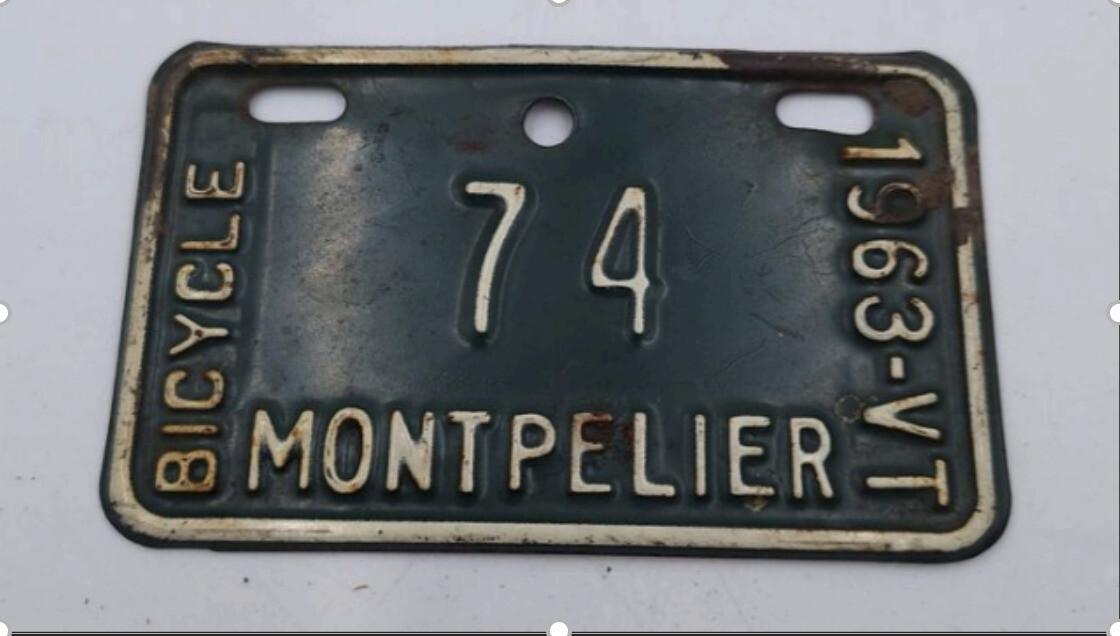
The license plate pictured above differs from the traditional forest green Vermont plate with which we are familiar. In place of the current “Green Mountain State” inscription, it reads “Bicycle,” “Montpelier,” and “1963-VT,” alongside a unique registration number. To modern eyes, it raises a simple question: did the city really once require bicycles to carry license plates?
The idea of a bicycle registration system entered public discussion in an article in the Montpelier Evening Argus published on Saturday, May 24, 1952. The article announced a joint meeting between the Recreation Board and Police Committee of the City Council to discuss a plan for increasing bicycle safety. Montpelier’s proposed system was modeled on one already in use in Rutland, with the goal of encouraging safety and responsibility among minors as bicycles became increasingly popular with younger residents. Nearly two years later, on Friday, March 26, 1954, another Montpelier Evening Argus article announced that bicycles would soon need to be registered.
The new plan required all bicycles in Montpelier, and the surrounding Washington County, to be registered by April 1, 1954. The police department collected a fee of 25 cents per bicycle and conducted an inspection to determine whether it was in sound operating condition. Each bicycle was also required to have a working light and horn. After passing the inspection, the owner received a unique Montpelier license plate to be mounted on the rear of the bicycle.
Although the registration fee was small, compliance with the ordinance was not optional. The Montpelier Evening Argus reported several cases involving young riders accused of violating the city’s bicycle rules, and some of the resulting punishments might make a modern reader scratch their head. During one hearing, penalties included a two-week license suspension, a court-ordered 500-word essay, and the required hand-copying of the city’s bicycle rules between 10 and 20 times.
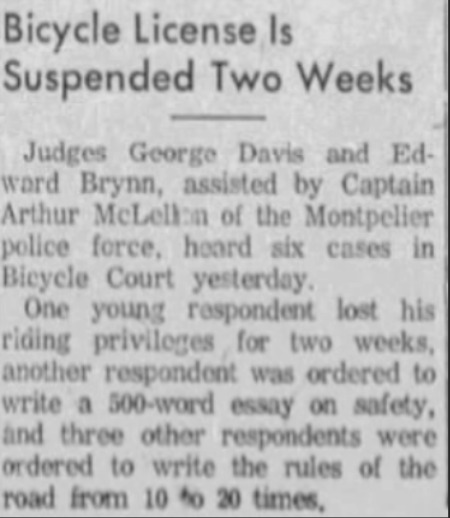
“Bicycle License Is Suspended Two Weeks,” The Barre Daily Times, Barre, Vermont. Published Sat, Sep 13, 1958.
The date on the license plate in the VHS collection shows that Montpelier’s system remained in operation for at least nine years after the 1954 registration announcement. In 1972, a new ordinance replaced the metal plates with a system based on stickers and serial numbers.
This surviving plate reflects a period of great change, where bikes and cars shared the roads to an even greater extent than they do today, and a period when Montpelier treated bicycle safety as a matter of formal city regulation, akin to that of modern-day motor vehicles, complete with inspections, licenses, and more varying penalties.