Exhibit Labels
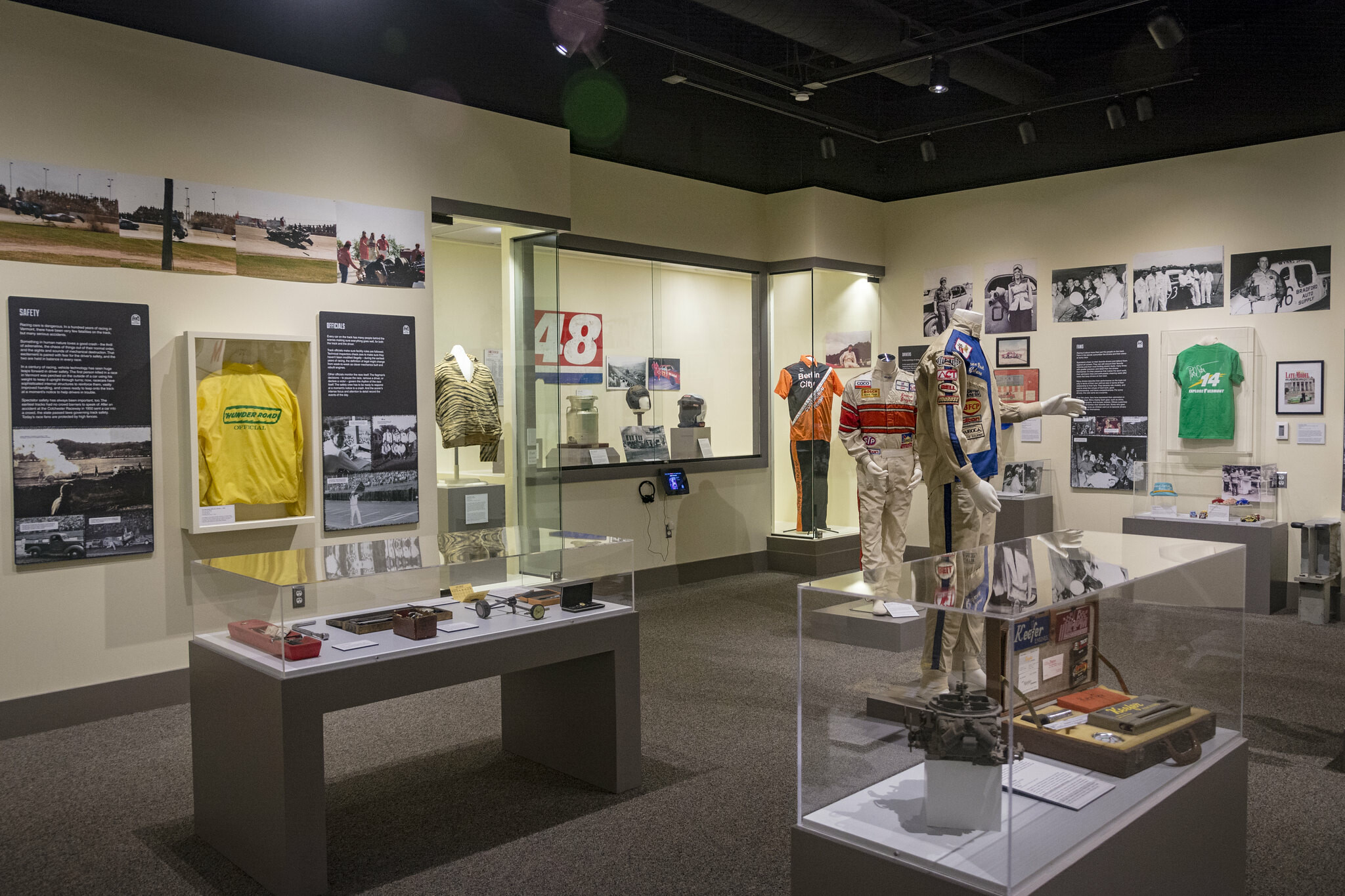
The 2018 exhibit “Anything for Speed: Automobile Racing in Vermont” featured a wide variety of label types, seen here: large panels with wall text, and smaller object-focused labels.
by Amanda Gustin, Director of Collections & Access
One of the most important ways that we help connect people to Vermont’s story is through putting the actual, physical stuff of history on exhibit. Like most museums, we only display a small fraction of our collections at any given time, and more than 95% of our collections are in storage. It takes hours to get an object ready for exhibit: checking its condition, researching its background, making sure everyone knows the object is moving, figuring out the best way to display it, and then writing a label.
Object labels are some of the most important means of communication with visitors. They provide a bridge between the curator who researched and chose the object and the interested person who is standing in a museum gallery and wants to learn more. When museums first began, as cabinets of curiosities, they often had very little explanatory information. Either visitors were expected to be smart, educated, and cultured enough to bring their own knowledge with them, or they were expected to be simply impressed and amazed by what they were seeing, with no need for further explanation.
As museums began to focus more on education – a trend led by Vermont-born John Dewey – labels became an important piece of communication. Physical, written labels placed next to objects could inform, ask questions, highlight a broader narrative, and help further a museum’s teaching goals.
You’ve probably visited many museums with different kinds of labels. Every institution thinks about its labels differently. Each object even has different labels depending on what curators want a visitor to notice about that object in the moment – its materials, its history of use, what ideas it represents, and new research and perspectives.
At the Vermont Historical Society, we’ve evolved and changed alongside the rest of the museum field. Today, we work hard to be thoughtful about our object labels. Most of the time, we start our labels with what is usually called “tombstone” information:
Object name or Art Title, Date(s)
Maker/Artist/Owner (Life Dates)
Place of Manufacture or use Material/medium
Credit line, object ID
In practice, here’s what that looks like:
Steam Engine, 1795-1815
Made by Samuel Morey (1762-1843)
Fairlee, Vermont
Brass, iron, lead
Gift of Amelia S. Morey Kibbey, #1900.2
After that, we could write many things, depending upon the context of the exhibit. The Morey steam engine is a crucially important object in Vermont history; it can symbolize invention, economic change, transportation, Vermont’s role in the early 19th century, local Orange County history, and more. How should we draw attention to the engine’s different roles in history? What is significant, what sparks interest and excitement, and what do we want people to think about even after they’ve left the museum?
Some years ago, the USS Constitution Museum researched what makes effective exhibit design for intergenerational groups in their “Engage Families” project. They asked: How does an exhibit present history so that everyone – children and adults together – can be engaged and learn? They found that less is more: chunks of text should be no more than fifty words, and they should be surrounded by images that convey information in a different way. They tracked how long people spent in their exhibits. Though it might seem counterintuitive, families spent longer in an exhibit with less text,– and maybe most important – they talked to each other more about what they were seeing.
As we are writing, revising, and designing the object labels for our 50 for 250 exhibition, which will open on July 3, we are faced with these challenges. Every object has been extensively researched and has its own 1,500+ word essay in our book that accompanies the exhibit. How do we summarize those ideas and that information? How do we get people to leave the exhibit thinking about all the different stories that have made up the last 250 years of Vermont’s history?
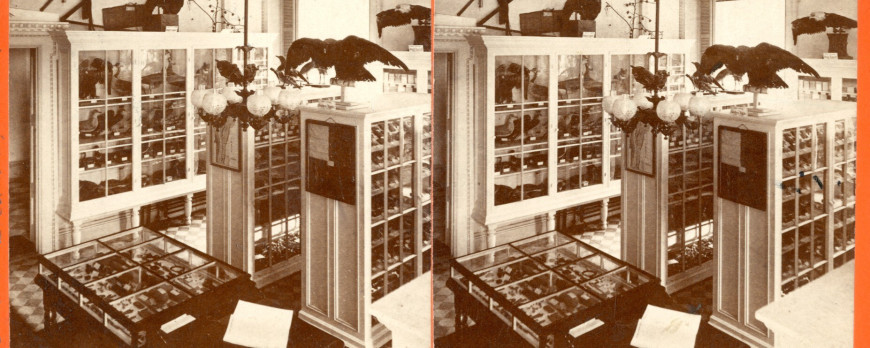
The Vermont Historical Society’s collections were originally exhibited much more as a cabinet of curiosities than as an interpreted educational space.