
Museum Catalog
The Vermont Historical Society houses over 25,000 objects relating to our State's history. Over the next five years all of these items will be digitally documented and placed in this catalog for public use. Items are presented in topical exhibits as well as categorical groupings. Please check back regularly as items will be added monthly. This catalog also houses the Vermont Women's History Database and the Vermont Black History Database.
Search All Categories
Geiger Counter
Interpretative Labels
Label
Geiger Counter, 1957
Chatham Electronics
Metal, rubber, plastic
Given in Memory of Dr. O.S. Peterson, Jr., 2004.35.1ab
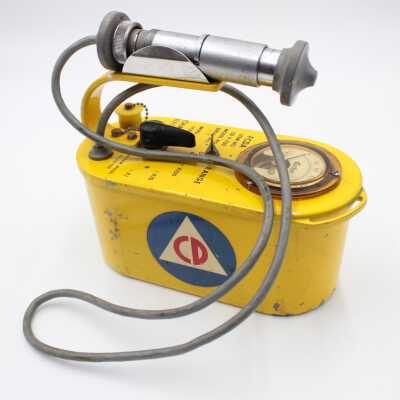
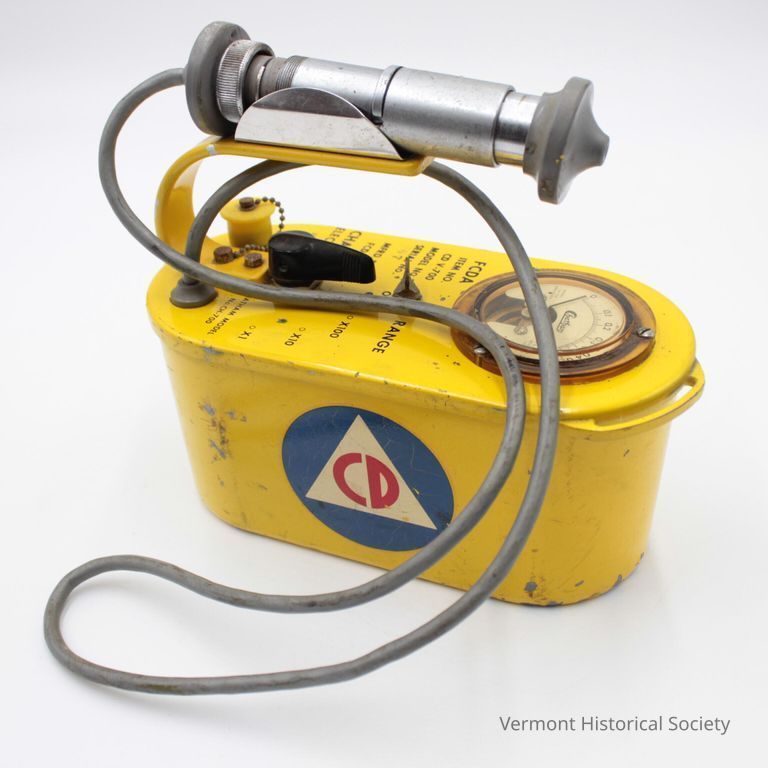
A Geiger counter, named after scientist Hans Geiger, is a device used to detect and measure radiation. The unit consists of two parts: a probe and the body, which has a measurement window as well as the Geiger-Muller tube, which actually registers the radiation. Geiger counters are inexpensive, easy to use, and widely available pieces of technology.
The world entered the atomic age after the US bombings of Hiroshima and Nagasaki, and for several decades the threat of a potential nuclear war gripped both the public and the American government. National civil defense programs produced short films, radio ads, pamphlets, posters, and other educational programs designed to educate citizens about how to act after a nuclear attack. Those decades of preparation, worry, and international diplomatic maneuvering are today known as the Cold War.
The Geiger counter in the collection of the Vermont Historical Society was used by Dr. Oscar S. Peterson, Jr. in his role as radiological officer for the State Civil Defense Agency. (The “CD” symbol on the side of the unit stands for Civil Defense.) It formed part of his personal kit, intended to detect and investigate any signs of nuclear fallout.
The Cold War was a period during which Vermonters had a complicated relationship with innovation and technology. They had to integrate both the threat of nuclear war and the fast-paced advances of modern society in their worldviews simultaneously. Few things illustrate this tension quite like a Geiger counter, which was meant to be used in a disaster scenario – but could guide the way to safety.
Name/Title
Geiger Counter
Entry/Object ID
2004.35.1a
Description
Yellow geiger counter and instruction manual. The counter has a rectangular yellow case with curved ends. Each long side has a log consisting of a white triangle inside a blue circle with the letters "CD" in red. A dial on the top has a numerical range from 0 to 0.5., and is encased beneath a plastic cover, held on with screws. The printing on the top of the case reads, "FCDA / ITEM NO. / CD V-700 / MODEL NO. 3 / SERIAL NO. / 667 / MFRD. FOR / FCDA BY / CHATHAM / ELECTRONICS / LIVINGSTON / NEW JERSEY". There are two black plastic knobs and a yellow plastic plug on the top of the case. A U-shaped bar extends from the case to act a both a handle and a holster for a silver-toned tube, connected to the case by a rubber-encased cord, and capped on either end with rubber. The counter is accompanied by a 15-page manual entitled "Radiological Survey Meter / FCDA ITEM NO. CD V-700" printed in black and white on glossy paper.
Context
Used by Dr. Oscar S. Peterson, Jr. while working with Civil Defense in Vermont
Acquisition
Accession
2004.35
Made/Created
Manufacturer
Chatham Electronics
Date made
1957
Dimensions
Height
7 in
Width
4 in
Length
7-3/4 in
Materials
Material
Aluminum, Rubber, Plastic
Relationships
Related Person or Organization
Peterson, Oscar S., Jr. (1912-1988), University of Vermont
Web Links and URLs