
Women Get the Vote, 1920
Oral history transcriptions
Click a name below for more information. All transcripts are in PDF format.
Background information
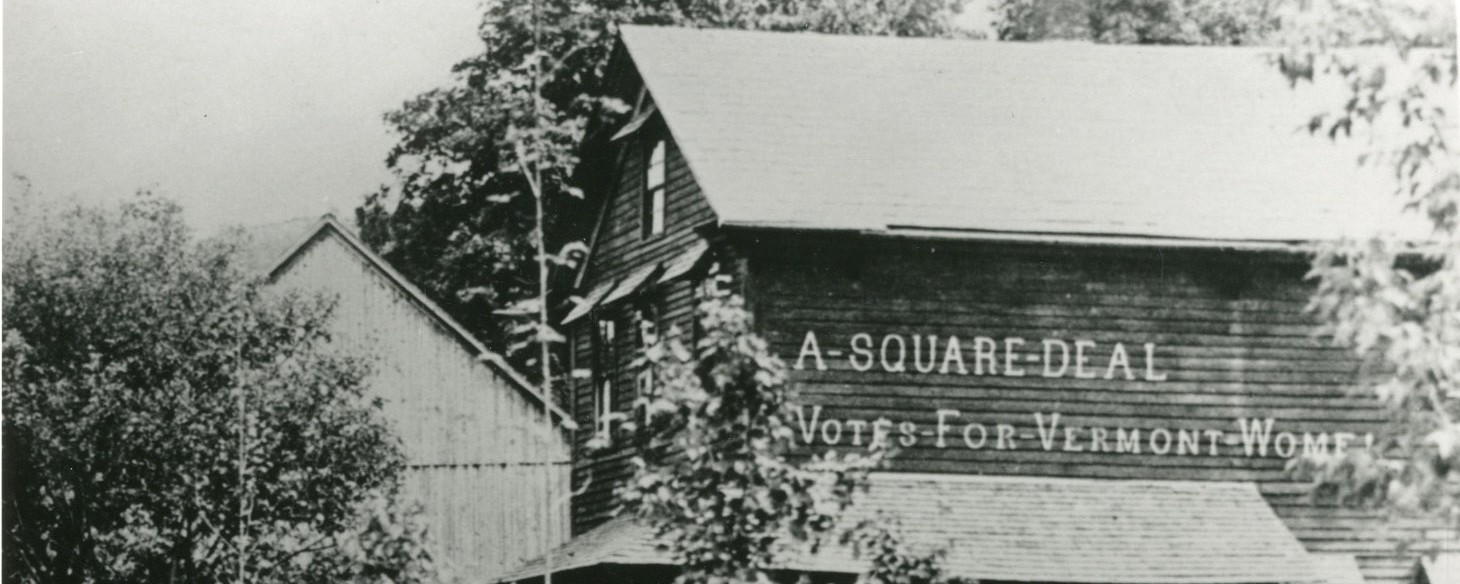
 When full woman suffrage came to the nation in 1920, a goal was achieved which Vermonters had been actively working toward for at least fifty years. A drive for voting rights had been made in the state as early as 1870, and other efforts followed, always without full success. Nevertheless, in 1880 the Vermont legislature did grant tax-paying women the right to vote in school district meetings, and women were allowed to hold school offices or to be elected or appointed as school superintendents or town clerks; in 1900 women became eligible to become notaries public or trustees of public libraries, and in 1902, town treasurers.
The principle organization in the state lobbying for these gains after 1907 was the Vermont Equal Suffrage Association (VESA), a statewide group of activist women. Organized in the early 1880s as the Vermont Woman Suffrage Association, it focused efforts on persuading the state legislature to act on women’s political rights. It also sent representatives to the National American Woman Suffrage Association, and later the Congressional Union for Women’s Suffrage, which pushed for suffrage action at the federal level.
 Many women in the leadership of VESA, were also active in other reform movements of the day, such as temperance, and religious missionary work. The Vermont Woman’s Christian Temperance Union (WCTU) was apparently especially valuable in providing leadership experience for the suffrage efforts. To fund its projects, VESA collected $1.00 membership fees for its State Association, and $.25 for membership in local “Equal Franchise Leagues” which existed in the state’s large towns of Burlington, Montpelier, Rutland, Springfield, and St. Albans.
Annual statewide conventions were held from 1885 through 1920, meeting in a different Vermont community each year. These gatherings were often festive occasions and major events for the communities involved. Delegates were usually warmly received. Store-keepers dressed their windows and U.S. flags and suffrage banners were hung in streets. Meetings were held usually in the town hall and typically included, in addition to suffrage speakers, such events as devotional exercises, a repeating of the Lord’s Prayer, and the singing of such songs as “Battle Hymn of the Republic.” VESA’s legislative committee presented lengthy reports on the year’s legislative session in Montpelier. After 33 years of women’s agitation for suffrage, Vermont passed legislation allowing taxpaying women to vote in town meetings in 1917.
Despite these efforts, and although eleven other states had succeeded in granting full suffrage to women, it was federal action that finally brought the full vote to the women of Vermont. In 1917, when the U.S. entered World War I, the U.S. House of Representatives finally agreed to create a committee on woman suffrage. By June 4, 1919, the 19th amendment had passed both houses of Congress and was sent to state legislatures for ratification. The Vermont Legislature passed full suffrage for women in 1919, but Governor Percival Clement, an opponent of woman suffrage, vetoed it. By 1920, with only one more state needed to ratify the federal amendment, Clement resisted strong pressure within the state to call a special legislative session to consider ratification. He argued that it would require a vote by the people and the state could not afford the expense involved. The Nineteenth Amendment became the law of the land on August 26, 1920 and Vermont General Assembly ratified it in 1921
 Vermont women took immediate advantage of their enfranchisement. In the 1920 gubernatorial election, Clement’s candidate was defeated in the Republican primary by James Hartness, who had been a leading voice on a state committee to ratify the Nineteenth Amendment. According to estimates, Hartness captured about 75 percent of the 10,000 or more votes cast in the election by women. Their impact was felt in other ways, as well. The presence of women at the November polls in Northfield brought a change in the appearance of the town hall polling location. Sawdust, which traditionally had been spread over the floor to absorb tobacco juice, was removed; smoking in the building was disallowed; and chairs were judiciously placed along the walls to provide opportunity for female voters to sit. The local newspaper reported that “Quite a number of the female voters of the town cast their votes as if they had done so for years.” The most dramatic change, however, came in 1921, when Edna L. Beard of Orange won a seat in the state House of Representatives, becoming the first woman member in the history of the Vermont legislature.
In 1920 the Vermont Equal Suffrage Association welcomed into existence the newly formed Vermont League of Women Voters. VESA held its last state convention in that year in conjunction with the new organization, and then disbanded.
—Gene Sessions (revised 12/16/19 and 2/3/2020 by Marilyn Blackwell)
Citation for this page
Woodsmoke Productions and Vermont Historical Society, “Women Get the Vote, 1920,” The Green Mountain Chronicles radio broadcast and background information, original broadcast 1988-89. https://vermonthistory.org/women-get-vote-1920

