
Vermont Country Fairs, 1924
Oral history transcriptions
Click a name below for more information. All transcripts are in PDF format.
Background information
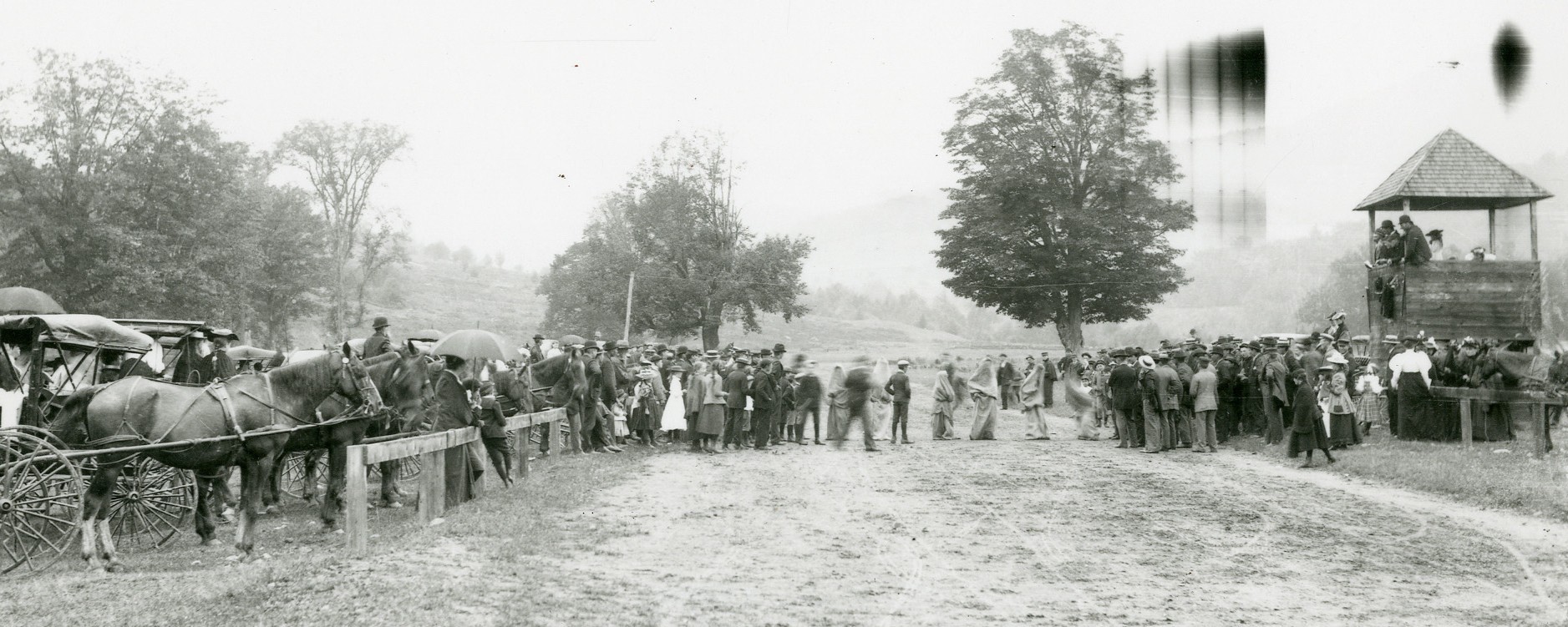
 Agricultural fairs have been popular annual attractions of Vermont’s summer and fall seasons for at least 150 years. Fairs, as “a special kind of gathering for buying and selling, for holding contests, and for having a good time,” have existed since ancient times. The earliest commercial, or market, fairs evolved in medieval Europe, where they served as centers of European trade. In the United States, in the nineteenth century, fairs became major institutions of agricultural society. However, with their emphasis on plowing competitions, livestock exhibits and prizes for the best examples of products of the agricultural household, the American agricultural fair differed markedly from the fairs of Europe and those of the American colonial period. Apparently the first such fair in the United States was held in 1810 by the Berkshire Agricultural Society in Pittsfield, Massachusetts.
By the 1840s and 1850s, county agricultural societies had been formed in Vermont and in many other parts of New England. A principle purpose of the societies was the holding of an “annual exhibit” or fair. Farm families brought their best livestock, produce, baked goods, and needlework for competition and blue ribbons. They exchanged information about improving the quality of their crops, and they enjoyed the opportunities for social exchange and good fun. In Vermont, the Caledonia Cattle Fair was organized as early as 1834. After 1838 annual shows were held for a number of years, eventually being superseded by the Caledonia County Agricultural Society, which was founded in 1844 in St. Johnsbury. The Society’s first county fair was held that year. The Rutland County Agricultural Society was formed and held its first fair in 1846 at Castleton. Except for 1917, when no fair was held in the state because of a polio epidemic, the Rutland fair has been an annual event ever since. In the 1840s annual fairs were also begun at Bennington, St. Albans, Burlington, and in Orleans and Addison counties. In September 1853, a “Vermont State Fair” was held on Seminary Hill (now the site of Vermont College) in Montpelier. Prizes at these fairs generally were provided with the aid of state appropriations and fairground gate receipts.
Facilities to support the fairs’ activities typically required permanent structures, and thus, permanent expenses. The fairs’ profits each year went largely toward upkeep and improvements. Nevertheless, the financial demands for producing the fairs typically outran the funds of sponsoring agricultural societies of fair stockholders. After World War II, state profits from newly legalized pari-mutuel betting were distributed to the fairs by the State Agricultural Department. Pari-mutuel betting was eventually repealed but a stipend was then established by the state legislature for annual allocation to the fairs. According to Everett Willard, head of the Agriculture Department’s Development Division, the stipend funds have enabled some annual fairs to continue in existence which otherwise would have folded, and contributed to making others financially stable.
 During the twentieth century, Vermont’s agricultural fairs continued the tradition of combining agricultural education and promotion of the state’s farm products with old fashioned fun. The annual Vermont Agricultural Report of the century’s early years variously stated the purpose of fairs to be “the practical education of the farmer” and the “dissemination of knowledge respecting the resources of the state.” But to many in Vermont’s largely rural, isolated population, especially in the years prior to World War II, the annual fair was viewed as a holiday event, one of the entertainment features of the year. A Vermont observer in 1911 observed that “the county fair is about the only legalized good time left to the country people.” The fairs invariably took on attributes of a circus, with the carnival barker and the “midway” attracting the fair’s largest crowds (and producing its most sizable profits). By late twentieth century at the larger fairs the midway and carnival activities played an increasingly expanded role. The Tunbridge Fair, in particular, became famous for its “tradition of insobriety” and as a place where “the carnival spirit runs rampant.”
Nevertheless, the number of agricultural fairs held annually in the state has gradually fallen since the turn of the century. From approximately twenty-five in 1900, the numbered of scheduled fairs and “field days” had been reduced to approximately fifteen by the late 1980s. Several factors influenced the numerical decline. The Great Depression triggered the demise of fairs at Springfield, White River Junction, Brattleboro, and perhaps elsewhere. The lessening importance of farming in the state’s economy following World War II reduced the fair’s agricultural constituency (the number of dairy farmers in the state shrank from 19,000 in the 1950s, to less than 3,000 by the late 1980s, to 987 in 2011. Radio, television, and other new information sources, such as the internet, have enabled the farmer to be less reliant on annual fairs for the latest knowledge on improvements in agricultural methods. The penetration of the state’s rural areas by the automobile, motion pictures, and television, has reduced the fairs’ function as a major entertainment attraction.
Despite their numerical decline, Vermont’s agricultural fairs and field days remain popular and successful. From one-day events, most of today’s fairs have expanded to two, four, or even eight to ten days, as with the current Champlain Valley Exposition at Essex Junction and the Vermont State Fair at Rutland. The percentage of participation by Vermont farm families in fair exhibitions and competitions is higher, and the quality of the competition itself increases yearly. Attendance also continues to increase. The continuing strength of Vermont’s fairs is due partly to the growing attraction they have for tourists, but also to their enduring effectiveness as an expression of the lives of rural agricultural Vermonters.
—Gene Sessions
For further reading:
Charles Fish, Blue Ribbons and Burlesque : A Book of Country Fairs. (Woodstock, Vt.: Countryman Press ; New York : Distributed by W.W. Norton, 1998).
Edward Hoagland, “Americana by the Acre” Harper's Magazine (October 1970):109-119.
Vermont Agency of Agriculture, Food, and Markets. Fairs, Festivals, Field Days & other Agricultural Events, https://agriculture.vermont.gov/fairs-fielddays
Citation for this page
Woodsmoke Productions and Vermont Historical Society, “Vermont Country Fairs, 1924,” The Green Mountain Chronicles radio broadcast and background information, original broadcast 1988-89. https://vermonthistory.org/vermont-country-fairs-1924

