Vermont Historical Society

  • Visit
    • Vermont History Museum
    • Vermont Heritage Galleries
    • Leahy Library
    • Events & Calendar
    • Group Tours & Field Trips
    • Hours & Directions
    • Contact
  • Educate
    • Field Trips
    • Vermont History Explorer
    • In Your Classroom
    • Vermont History Day
    • Homeschool
    • Online Resources
    • Professional Development Workshops
  • Research
    • Leahy Library
    • VHS Library Online Catalog
    • Research Resources Online
    • Ask a Librarian
    • Museum Collections
    • Genealogy
    • Archaeology
    • Vermont Women's History
    • Publishing Program
  • Virtual VHS
    • Online Exhibits
    • Photographs
    • Film and Video Collection
  • Shop
    • All Store Items
    • Recent Additions
    • VHS Publications
    • Sale Items
  • Community Resources
    • Collections Care
    • League of Local Societies & Museums
    • League of Local Societies & Museums Directory
    • Community History
    • Vermont History Expo
    • Other Helpful Links
  • About VHS
    • Mission & Strategic Plan
    • News & Publications
    • Staff & Trustees
    • Fellowship & Awards
    • Membership
    • Rent a Conference Room
    • Hours & Directions
  • Support
    • Join, Renew, Donate
    • Planned Gifts
    • Company Sponsorships
    • Vermont Forever
    • Volunteer
  1. Home
  2. >>
  3. Research
  4. >>
  5. Research Resources Online
  6. >>
  7. Green Mountain Chronicles
  8. >>
  9. Memories of Silent Cal

Memories of Silent Cal

  • Print
  • Email

Green Mountain Chronicles Radio show

In order to view this object you need Flash Player 9+ support!

Get Adobe Flash player

Powered by RS Web Solutions

Oral history transcriptions

Click a name below for more information. All transcripts are in PDF format.

  • Elizabeth Ballard
  • Evelyn Whittemore
  • Mary Pratt
  • George Selders
  • Ermine Pollard

Background information

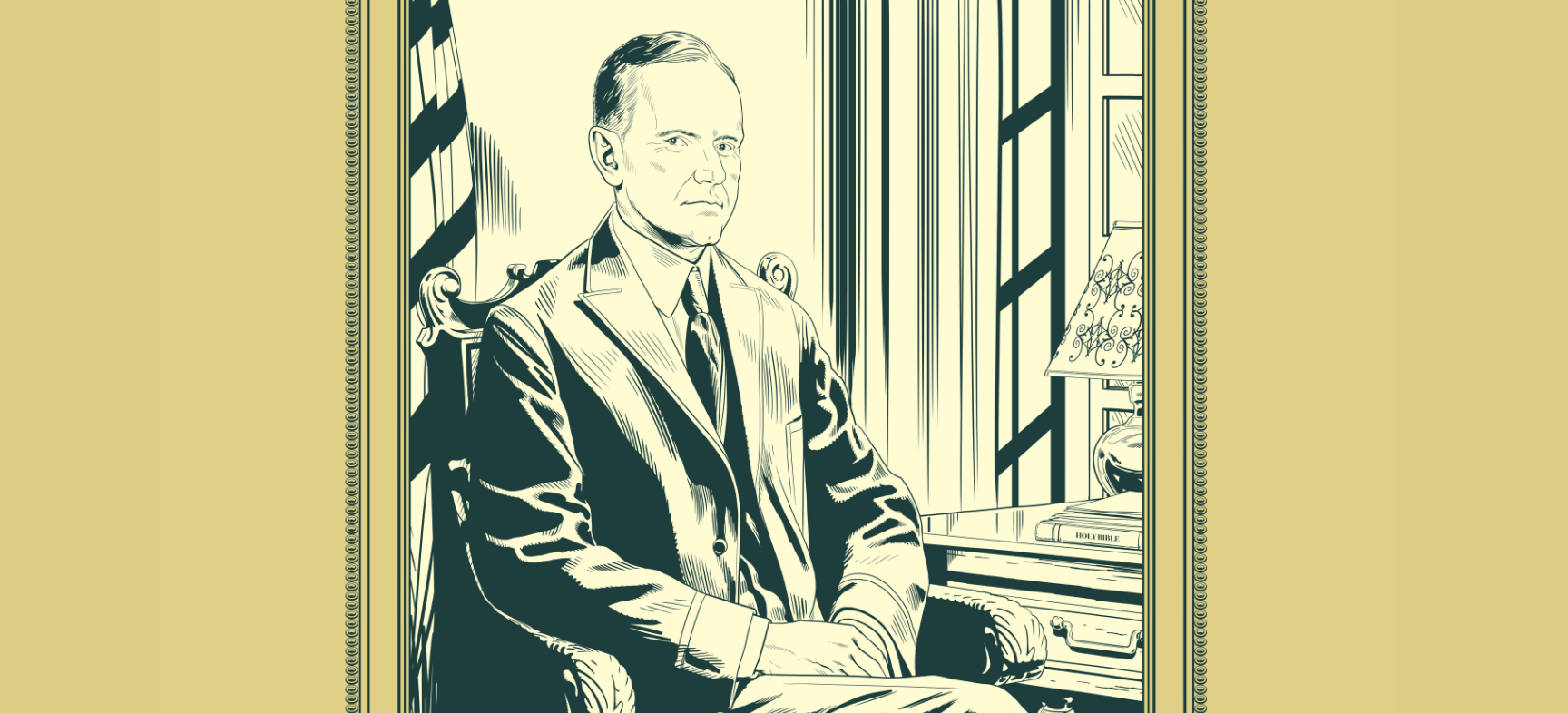
Calvin Coolidge, August 1923Calvin Coolidge repairing a tree in Plymouth, Vt., the day before he became president, August 1923Calvin Coolidge became president of the United States as a consequence of Warren Harding’s death from a cerebral embolism on August 2, 1923. Coolidge completed Harding’s term and was elected to a term of his own in 1924, finally leaving office in March 1929. He was fortunate to have been president during a period of relative peach and expanding apparent prosperity. His conservative Republican policies of inaction toward domestic and international problems came to symbolize the era between World War I and the Great Depression. He skillfully restored integrity to government following the Harding scandals, and his plain-and-simple style was an appealing sign of calm and stability during the Roaring Twenties.

Coolidge was born on July 4, 1872, in tiny Plymouth Notch, Vermont. He represented the fifth generation of a family that had cleared land around Plymouth during the American Revolution. His grandfather owned the country store; and his father farmed, ran the annual town meeting, and served terms in the Vermont House and Senate. As a boy, Calvin worked hard at farm chores, attended a one-room school house, and led a simple life, seldom venturing beyond the Notch. His father said the he “never made any rules for Calvin to follow. If there are rules, it gives a boy a chance to break them. I told him to do his work well, and he always did. That was what my father taught me, and that was what his father taught him.”

Calvin Coolidge tilling in Plymouth, Vt.Calvin Coolidge tilling in Plymouth, Vt.After finishing public school, Calvin spent four years at Black River Academy in Ludlow and one semester at St. Johnsbury Academy, and then entered Amherst College in Massachusetts. He practiced law in Northampton after graduation, met and married Grace Goodhue, from Burlington, Vermont, and gradually made his way up the political ladder in Massachusetts to become governor in 1918. He gained national fame through his handling of the Boston Police Strike of 1919, earning himself a place on the national Republican ticket with Warren Harding in 1920. Harding’s death three years later put Coolidge in the White House.

At the time Coolidge became president he had never been outside the United States and seldom outside New England. Nevertheless, he had traveled a considerable distance from his rural Vermont childhood. In fact, the British ambassador commented, “I never say a man who looked less like the son of a farmer” (Arthur Schlesinger, Jr., Crisis of the Old Order, p. 56). Coolidge, however, returned often to Vermont, to visit his father at Plymouth Notch. He was there when he learned of Harding’s death; and it was in the living room of the family farmhouse by the light of an oil lamp that his justice-of-the-peace father administered the oath of office as president. Because his father had refused to have a telephone, the nearest one was in the store across the road, and it was from that phone that he received the advice from Secretary of State Charles Evans Hughes to take the oath of office immediately. The next day, telephone linemen strung a wire into his father’s house.

Calvin and Grace Coolidge, Swampscott, Mass.Calvin and Grace Coolidge and their favorite pet in Swampscott, Mass.Although Coolidge left the Green Mountain State at age 19, his rural Vermont background stamped his personality, philosophy, and leadership. By most meansures he was an unspectacular man. Small of build, with sandy hair, a high forehead and prominent nose, he was not impressive physically. Nor was he a gifted speaker; his voice had a nasal twang, and his habit of speech was brief, direct, and prone to silvery platitudes. In personal relations he was “silent Cal,” serious and aloof. One story suffices to illustrate his well-know “closedmouthedness.” During the 1924 presidential campaign a newsman sought Coolidge out. “Mr. President,” he asked, “what do you think of Prohibition?” “No comment,” replied Coolidge. “Will you say something about unemployment?” “No,” said Coolidge. “Will you tell us your views about the world situation?” persisted the reporter. “No.” “About your message to Congress?” “No.” The disappointed reporter started to leave, but as he reached the door Coolidge said, “Wait.” Hopefully, the man turned around and Coolidge cautioned: “Now remember—don’t quote me.”

These characteristics, along with his severe public dignity, diffidence, shrewd political common sense, and numerous eccentricities (preserved in widely circulated anecdotes, may of which were authentic) are generally attributed by his biographer to the narrow austerity and rural isolation of his Vermont youth. They were, as well, apparently, the key to his enormous political popularity: He epitomized cherished virtues that seemed to be rapidly vanishing during the Jazz Age decade.

From history’ perspective, Calvin Coolidge is the most obscure of twentieth-century U.S. presidents. Yet, public attention turned to him again, briefly, with the election of Ronald Reagan to the presidency. Reagan chose to hand a portrait of Coolidge in the cabinet room of the White House. He admired Coolidge for his success in reducing taxes and government expenditures, but also for his vision of American, which, like Reagan’s own, was nostalgically rooted in small town and rural values of a time gone by.

—Gene Sessions

For further reading:

Donald R. McCoy, Calvin Coolidge, the Quiet President (1967).

William Allen White, A Puritan in Babylon: The Story of Calvin Coolidge (1938)

Paul Boller, Presidential Campaigns (1984): 218-222.

Howard F. McMains, ed. “Retort and Ripostes: President Coolidge’s Cabinet Room Humor,” Vermont History 54 (1986): 229-232.

James Morgan, Our Presidents (1935): 299-317.

Calvin Coolidge Memorial Foundation, http://www.calvin-coolidge.org/

Citation for this page

Woodsmoke Productions and Vermont Historical Society, “Memories of Silent Cal,” The Green Mountain Chronicles radio broadcast and background information, original broadcast 1988-89, accessed on the web at http://vermonthistory.org/silentcal.

  • Leahy Library
  • VHS Library Online Catalog
  • Research Resources Online
    • Sanborn Fire Insurance Maps
    • Green Mountain Chronicles
      • Dewey Day: A Century Ends, 1899/1900
      • The Age of Trolleys, 1901
      • Early Autos in Vermont, 1902
      • Dorothy Canfield Fisher, 1907
      • “Number Please”: The Telephone Comes to Vermont, 1910
      • The Long Trail, 1910
      • Early Aviation, 1910
      • The 4-H in Vermont, 1914
      • Traveling Entertainment: The Chautauquas, 1915
      • World War I: Camp Vail, 1916
      • The 1918 Flu Epidemic, 1918
      • The Co-op Movement, 1919
      • Early Days of Radio, 1920
      • Prohibition, 1920
      • Women Get the Vote, 1920
      • The Anarchist Movement in Barre, 1920
      • Edna Beard: Vermont’s First Woman Legislator, 1921
      • The K.K.K. in Vermont, 1924
      • Walter Hard, Sr.: Vermont’s Storekeeper—Writer, 1924
      • Vermont Country Fairs, 1924
      • Memories of Silent Cal
      • The Flood of ‘27, 1927
      • Vermont in the Great Depression, 1929
      • Collecting Old Songs: Helen Hartness Flanders, 1930
      • Fighting the Depression: The C.C.C., 1933
      • The Green Mountain Parkway, 1933
      • A Symphony is Born: The VSO, 1934
      • The Early Days of Skiing, 1934
      • The WPA, 1935
      • The OWLS: Vermont’s Women Legislators, 1936
      • Fighting Silicosis: Dust Control in the Granite Industry, 1937
      • Robert Frost: Poet Laureate, 1938
      • World War II at Home, 1942
      • Turning on the Lights: Electricity Comes to Rural Vermont, 1943
      • Senator Ralph Flanders, 1946
      • Town Bands, 1946
      • Maple Sugaring, 1947
      • The Case of Alex B. Novikoff, 1953
      • The Coming of the Bulk Tanks, 1954
      • Consuela Northrop Bailey, 1954
      • Hi-Tech Comes to Vermont, 1957
      • Democrats Rising, 1958
      • Dowsing in Danville, 1961
      • Legislative Reapportionment, 1965
      • The Aiken Formula, Myth and Reality, 1966
      • The VT/NY Youth Project, 1968
      • Back to the Land: Communes in Vermont, 1968
      • Act 250, 1970
      • The First Vermonters: The Abenakis, 1976
      • School Consolidation: Farewell to the One-Room Schoolhouse, 1986
      • Railroads, 1989
      • Overview, 1900-1989
    • Manuscript Transcriptions
      • James & Julia Hope Letters
      • Erastus P. Williams Diaries
      • Teddy Roosevelt Re-enactment
    • Civil War Transcriptions
      • Non-Military
      • Martha Johnson
      • Military
      • Charles Buxton Diary
      • William P. Calvert letter
      • Charles Chapin diary
      • George R. Crosby diaries
      • Charles Cummings letters
      • Alonzo C. Farmer letter
      • George Oscar French letters
      • Walter Graham diary
      • Walter Graham letters
      • William Hogan letters
      • Edwin Horton letters
      • George W. Humphrey letter
      • Alfred Horton Keith letters
      • Dan Mason letters
      • George E. Parker letters
      • John W. Phelps requisition
      • William "The Sleeping Sentinel" Scott letters
      • Orlando S. Turner letters
      • Daniel S. White letters
      • William White letters
      • James Willson letters
    • Civil War Research Resources
    • Vermont History Journal
      • Selected Articles, 1921 - 1960
      • Selected Articles, 1961 - 1999
      • Civil War Articles
      • Volume 68 (2000)
      • Volume 69 (2001)
      • Volume 70 (2002)
      • Volume 71 (2003)
      • Volume 72 (2004)
      • Volume 73 (2005)
      • Volume 74 (2006)
      • Volume 75 (2007)
      • Volume 76 (2008)
      • Volume 77 (2009)
      • Volume 78 (2010)
      • Volume 79 (2011)
      • Volume 80 (2012)
  • Ask a Librarian
  • Museum Collections
    • Quilt Collections
      • Gallery 1
      • Gallery 2
      • Gallery 3
      • Gallery 4
      • Gallery 5
      • Gallery 6
      • Gallery 7
      • Gallery 8
      • Gallery 9
    • Faces of Vermont
      • The Chippenhook Family Group
      • The Warren Family
      • Rena Guernsey
      • Daniel Pierce Thompson
      • Lucy Ainsworth Cooke
      • The Whipples
      • Private William Scott
      • William Czar Bradley
    • Rugg Collection
      • Rugg Collection Gallery
  • Genealogy
    • Genealogy Research at the VHS
    • Genealogy Research in VT
    • Genealogy Indexes & Lists
      • Brattleboro Area Irish Naturalizations
      • Lowell Town Records
      • Early Marriages
      • Marriages & Baptisms by Richard Bedford
      • Military Recruiting Photographs
      • Some Vital Records of the 19th Century
      • Washington County Deaths, Funerals, Births & Fires
      • Washington County Selective Service Board
  • Archaeology
  • Vermont Women's History
    • The Deborah Pickman Clifford Legacy Fund
  • Publishing Program
Cavalry-Flag.jpg

Not a member?

Learn how your membership can help preserve Vermont's heritage.

Vermont Historical Society
60 Washington St., Barre, VT 05641
(802) 479-8500

  • directions
  • Career Opportunities
  • contact
  • sitemap

Web site sponsored by: Schultz-Blackwell Trust