
The K.K.K. in Vermont, 1924
Oral history transcriptions
Click a name below for more information. All transcripts are in PDF format.
- Maudean Neill
- Deane C. Davis
Background information
 The Ku Klux Klan began as a secret terrorist organization in the South after the Civil War. Founded in 1866, the Klan was initially almost exclusively Southern and rural in its membership and its violent activities, which aimed at terrorizing the black population and resisting distribution of political power to the ex-slaves as part of Congress’s post-war Reconstruction plan. It effectively disrupted enforcement of local and federal laws throughout the South until congressional legislation, federal military arrests, and trials in federal courts significantly weakened the Klan in 1871-1872.
It revived in a somewhat altered form in the twentieth century. The new movement was organized in 1915 outside Atlanta, Georgia, and peaked in the 1920s. This new Klan had its roots more clearly in the American nativist tradition, but was still characterized by the white supremacy, hooded secrecy, and violent tendencies of its earlier counterpart. Stimulated by war-time (WW I) intolerance and economic complaints, it spread outside the South into the Midwest, Far West, and East, adding to the old Klan’s hostility toward blacks, an animosity toward Roman Catholics, Jews, foreigners, and organized labor.
The Klan movement in Vermont was not strong, but for about four years in the mid-1920s it did have a foothold and a significant presence in the state. National Klan officials claimed 10,000 members in Vermont in the early 1920s (population 352,428), but historian Kenneth Jackson believes a more reasonable estimate of the total number of Vermonters formally initiated in the Klan between 1915-1944 was approximately 2,000. (Jackson, The Ku Klux Klan in the City, 181, 237, 281). The growth of its membership was primarily fueled by prejudice against the Roman Catholic Church.
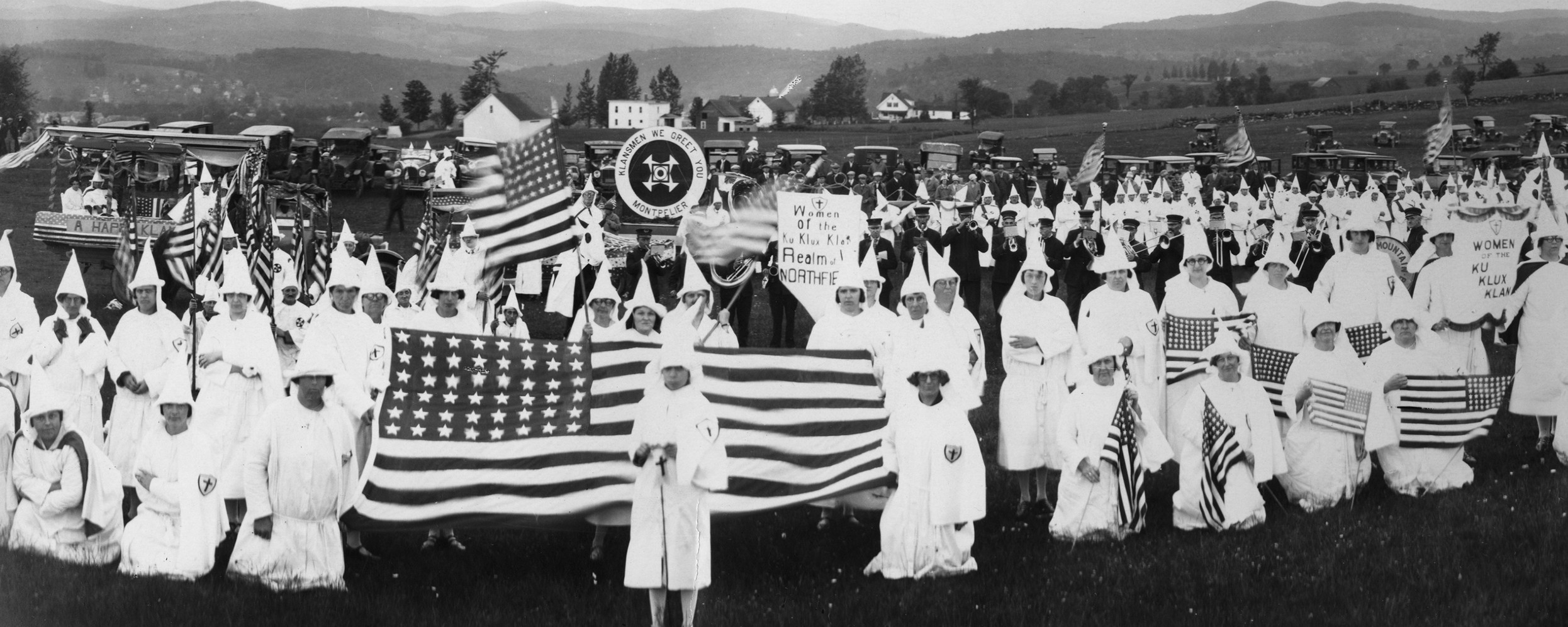
Klan organizers appeared in the state for the first time in spring 1922, but a serious membership drive did not begin until 1924, organized out of the northern New England Klan headquarters located at Rochester, New Hampshire. The organizers came from other states, many from Indiana. Their method was to work quietly at first, distributing literature, advertising in newspapers, and initiating members at secret meetings at which those who attended were sworn to secrecy. Admittance to such meetings often was gained only by inspection of invitation cards. By summer 1924, after several towns had been canvassed and members acquired, open meetings were held in fields and meadows, where large groups could assemble under a huge burning cross to hear speeches and initiate new members. At these events Klan members wore white robes and hoods.
Klan organizations gained a foothold in several Vermont communities. Springfield was the first town in the state to establish a chapter. Efforts at Bellows Falls, Bennington, and Rutland apparently gained a few memberships. In Washington County, Barre, Montpelier, and Northfield had apparently sizable Klan chapters. A chapter was formed in St. Johnsbury in fall 1924, and in September of that year more than 2,000 people from Vermont, Maine, and New Hampshire attended a public meeting there, with Klansmen in full regalia. The Chittenden County Klan was also begun in 1924. During the summer and fall of that year, fiery crosses were seen in Burlington on the breakwater of Lake Champlain, and in many other locations, including hilltops in Caledonia County, in Montpelier, Barre, Plainfield, and East Clarendon. At a state-wide meeting of the Klan at a farm on the outskirts of Montpelier in August 1925, a crowd of spectators and nearly 400 automobiles congregated for festivities which included a fireworks display.
The Vermont Klan promoted themselves as one-hundred percent American and in support of traditional morality. At a meeting in Windsor, on October 17, 1924, approximately 150 men listened to remarks explaining the Klan movement. It was reported that after asking all who were not white Protestants to leave, the main speaker tried to persuade his audience that negroes had a lower standard of morality than white men, that Jews were only interested in business success, and that in predominately Catholic populations, outsiders did not get a square deal. In Bethel, in August 1925, a divorced woman and a male boarder she had taken in received Klan letters accusing them of living immorally and warning the boarder to move out or be punished with tar and feathers. Catholics in Montpelier were the targets of cross burnings at their cemetery and on the steps of the Catholic church. When the Windsor Vermont Journal editorially criticized “hooded vigilantes” it received threatening letters of protest.
Resistance to the Klan’s presence in Vermont took a number of forms. The town of Rutland passed an ordinance outlawing parades or meetings in the streets by hooded or masked individuals or organizations. In Burlington, aldermen passed an ordinance prohibiting the wearing of masks in public. Several newspapers denounced Klan activities. The Bellows Falls Times criticized local Klan organizing efforts, warning that economic prosperity in town could not thrive on a foundation of community distrust. The Burlington Free Press said that Burlington needed the Klan as much as it needed a consuming plague and predicted that the Klan would find the territory about as poor picking as “Mormon missionaries or community agitators.” The St. Albans Messenger asserted that Klan organizing efforts would be frustrated by the “biting blast of Vermont common sense.” In Springfield, 143 citizens signed a petition to town officers opposing a Klan organizer’s activities in town, and the proprietor of a Springfield shoe store was the first candidate for town representative in the state to make the Klan a political issue by declaring the “The Ku Klux Klan is an un-American institution which no red-blooded American can tolerate.” A Rutland policeman who attended a Klan meeting was fired from his job, and anti-Klan citizens of Rutland organized a boycott against business and professional men whose names appeared on a list of alleged members. In East Clarendon, an open-air Klan meeting was suspended when eight cars of non-Klansmen approached the gathering; license plate numbers of cars at the meadow (and names) were published in the next day’s Rutland Herald. In Montpelier, an anti-Klan group was organized under the name “Knights of the Flaming Circle.”
Many Klan members were respected by other whites and were religiously-inclined citizens. Similar to the South, bible reading, prayer, and hymn singing were staples of Vermont Klan meetings, and for some members, it replaced Sunday church services. Others apparently saw the Klan as primarily a social and fraternal organization. One husband and wife in South Barre joined the Klan because a good friend who recruited them promised, in the bargain, that he and his wife would join the Grange. For still others, it offered a diversion from dull routine. The wife of a Montpelier Klan member said she and her husband had been involved in cross burnings for Saturday night excitement. Nonetheless, the Klan’s presence, its rhetoric of racial and religious prejudice, and its history of violence were justifiably causes for fear and concern.
The Klan’s decline in Vermont in the 1920s apparently followed the national pattern. Internal dissension, mishandling of chapter funds, and the national organization’s growing identification with violence all seemed to have been factors. South Barre Klan members began to drop out after money collected to buy uniforms was stolen by a fellow member. Money problems and internal dissension were factors in the Montpelier Klan’s collapse. The conviction of Klan members in Burlington on grand and petit larceny charges involving a break-in at St. Mary’s Cathedral of the Immaculate Conception contributed to the decline of Klan operations not only in Burlington but throughout the state. The last significant Vermont activity in 1927 was the grand parade of hooded Klansmen in Montpelier on July 4.
Gene Sessions
Revised February 17, 2016
For further reading:
Maudean Neill, Fiery Crosses in the Green Mountains: The Story of the Ku Klux Klan in Vermont (Randolph Center, Vt.: Greenhills Books, 1989).
Kenneth T. Jackson, The Ku Klux Klan in the City, 1915-1930 (New York: Oxford University Press, 1967).
Allen W. Trelease, “Ku Klux Klan,” in Eric Foner and John A. Garrity, Eds., The Reader’s Companion to American History (Boston: Houghton Mifflin Company, 1981): 625-626.
Citation for this page
Woodsmoke Productions and Vermont Historical Society, “The K.K.K. in Vermont, 1924,” The Green Mountain Chronicles radio broadcast and background information, original broadcast 1988-89. https://vermonthistory.org/kkk-in-vermont-1924

