
The Co-op Movement, 1919
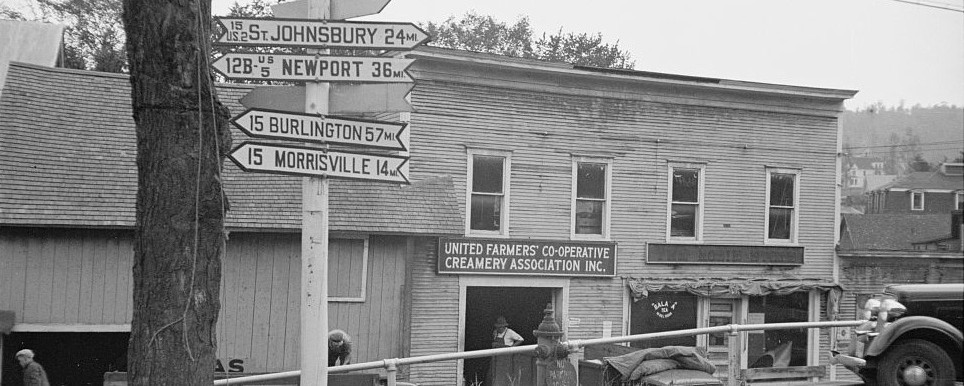
Since the first dairy coop in Vermont began marketing mild in 1895, there has been a steady growth in the volume of dairy products handled by these organizations and the scope of their services to Vermont’s agricultural community. Available statistics show two dramatic tendencies—the gradual dominance by coops over proprietary dairies in the marketing of milk, and the consolidation of the dairy coops themselves over time.
Background information
The coop movement has taken several forms in the United States, but has been with us since shortly after the American Revolution. Organizations such as the Philadelphia Society for Promoting Agriculture, the State Agricultural Society in Charleston, South Carolina, both of which flourished about 1785, and the Vermont Agricultural Society, founded in 1806, came into being in order to keep American farmers, especially gentry farmers, informed about changes and reforms in European agricultural practices. These were learned societies, however, more concerned with scientific agriculture than with problems such as marketing, financing stock, feed, and capital improvements. It was not until the middle of the nineteenth century that activist agricultural organizations made an appearance and began having an affect on agricultural practices and policies.
In the mid-1840s, Protective Unions began to be organized in Vermont. Using ideas imported to America from European social movements and collectivist social theories, the Protective Unions started by providing insurance benefits and pension plans, and then expanded their operations to include cooperative purchasing of food and supplies. By 1850, the high-point of the Protective Union movement, there were 181 divisions throughout New England and the Great Lakes area. Vermont had about forty units, more divisions than any other state. Many of those were organized by Wooster Sprague of Montpelier. By 1867, when the Protective Union movement broke up, there had been 152 unions or union stores in 129 Vermont towns. Some had lasted only a few years; a few had lasted more than a decade.
The diversity of activity of the Protective Unions pointed the way for subsequent collective and cooperative organizations. The Vermont Dairyman’s Association, founded in 1869, and the Vermont State Grange, organized in 1870, pursued a similar approach of legislative activism.
Vermont dairy farmers also turned to regional cooperative organizations such as the Milk Producers Union in the Boston area (flourish 1886-1911), the Boston Cooperative Milk Company (founded 1908), and the New England Milk Producers Association (NEMPA), the most successful of the bargaining cooperatives. These cooperatives concentrated their efforts on representing member dairy farmers in negotiating prices and transportation rates for their products, especially fluid milk, in the Boston market and insuring quality control for butter, cheese, and sweet cream. Vermonters were very active in NEMPA, with 5,810 of a total of 20,000 members throughout the region in 1922. The need for more local control, however, led Vermonters to form the Vermont Cooperative Creameries, Inc. in 1920. This federation of dairy farmers hired its own staff to buy supplies for the creameries and sell the products manufactured by member creameries in the Boston market. Although Vermont Cooperative Creameries had the support of Commissioner of Agriculture Elbert S. Brigham, it faced opposition from and rivalry with the more powerful NEMPA. In 1924, only six of the thirty cooperative creameries in Vermont were members of VCC.
A more radical organization, the Vermont Farm Bureau, emerged around 1918 from small county farm cooperative efforts. This organization became known as a leading political force, activist, anti-business, and radical. Under the leadership of Arthur Packard the Farm Bureau supported other cooperative and in 1941 took a leading part in forming the Vermont Cooperative Council.
By 1948 Vermont had nineteen coops marketing milk. More than 50 percent of the milk produced in Vermont was marketed cooperatively through producer-owned and operated plants, and an additional 25 to 30 percent of milk produced in the state was sold through coops and coop bargaining agents. In 1986, the Vermont Department of Agriculture listed six dairy coops operating in and through Vermont. In 2011, the department (renamed the Vermont Agency of Agriculture) listed five coops actively buying milk from Vermont farmers—only one of which, St. Albans Coop Creamery, has its headquarters in Vermont.
The successes of the early agricultural cooperative unions and cooperative organizations encouraged the formation of other specialized agricultural organizations, among them the Vermont Maple Syrup Association in 1893, the Vermont Horticultural Society in 1895, the Union Agricultural Council in 1935 (a federation of the Dairymen’s, Maple Syrup, and Horticultural Associations), and Shoreham Cooperative Apple Producers Association in 1949. Moreover, the coop movement diversified rather early and has continued into the twenty-first century to add activities such as operating freezer lockers, purchasing agricultural and consumer goods, providing short-term and some long-term credit, underwriting fire, life, and casualty insurance, and financing rural electrification.
 Consumer coops have grown steadily in Vermont, partly as a response to hard times and economic distress in the 1930s, partly as an aspect of the radical politics of the 1970s, partly in response to the natural foods and products, organic farm, and local ore movements of the 1990s and early 2000s, and partly as a vestige of agricultural economy in an increasingly urban population.
The Adamant Cooperative Store, oldest of its kind in the state, started in 1935. In 1974, Brian Vachon, writing in Blair and Ketchum’s Country Journal, reported on the Plainfield Food Cooperative. One of 180 food coops throughout New England and over 3,000 nationally at that time, Plainfield had 2,000 members with 35 mini-coops or outlets throughout central and northern Vermont. The Plainfield coop was part of New England Peoples Coop (NEPCOOP), which coordinated eight food coops in Vermont and New Hampshire. In 1978 the Plainfield Coop changed its name to Hunger Mountain Cooperative, moved to Montpelier, and reorganized to become a storefront operation in addition to doing pre-order bulk business. It is one of sixteen consumer coops currently operating in Vermont. More recently a new kind of coop, Community Supported Agriculture (CSAs), has appeared and proliferated throughout the state. These contractual arrangements between individual consumers and individual farmers provide consumers with a varied but guaranteed weekly quantity of farm products for a fixed price and provide farmers with up front cash, which helps them purchase seed and supplies and plan for distribution of their products. In 2011 the Vermont Agency of Agriculture lists 81 CSAs located throughout the state.
—Michael Sherman
Further reading
Hal S. Barron, Mixed Harvest: The Second Great Transformation in the Rural North, 1870-1930 (Chapel Hill: University of North Carolina Press, 1997)
Edwin C. Rozwenc, Agricultural Policies in Vermont, 1860-1945 (Montpelier, Vt.,: Vermont Historical Society, 1981), 143, et seq.
Harold Fisher Wilson, The Hill Country of Northern New England: Its Social and Economic History, 1790-1930 (New York: AMS Press, 1967)
Coop Directory Service, “Coop Directory Service Listing, Vermont”: http://www.coopdirectory.org/directory.htm#Vermont (accessed 6/9/11).
Vermont Agency of Agriculture, “Where to Find a Vermont CSA”: http://www.vermontagriculture.com/buylocal/buy/csa_map.html (accessed 6/9/11).
Citation for this page
Woodsmoke Productions and Vermont Historical Society, “The Co-op Movement, 1919,” The Green Mountain Chronicles radio broadcast and background information, original broadcast 1988-89. https://vermonthistory.org/the-coop-movement-1919

