Vermont Historical Society

  • Visit
    • Vermont History Museum
    • Vermont Heritage Galleries
    • Leahy Library
    • Events & Calendar
    • Group Tours & Field Trips
    • Hours & Directions
    • Contact
  • Educate
    • Field Trips
    • Vermont History Explorer
    • In Your Classroom
    • Vermont History Day
    • Homeschool
    • Online Resources
    • Professional Development Workshops
  • Research
    • Leahy Library
    • VHS Library Online Catalog
    • Research Resources Online
    • Ask a Librarian
    • Museum Collections
    • Genealogy
    • Archaeology
    • Vermont Women's History
    • Publishing Program
  • Virtual VHS
    • Online Exhibits
    • Photographs
    • Film and Video Collection
  • Shop
    • All Store Items
    • Recent Additions
    • VHS Publications
    • Sale Items
  • Community Resources
    • Collections Care
    • League of Local Societies & Museums
    • League of Local Societies & Museums Directory
    • Community History
    • Vermont History Expo
    • Other Helpful Links
  • About VHS
    • Mission & Strategic Plan
    • News & Publications
    • Staff & Trustees
    • Fellowship & Awards
    • Membership
    • Rent a Conference Room
    • Hours & Directions
  • Support
    • Join, Renew, Donate
    • Planned Gifts
    • Company Sponsorships
    • Vermont Forever
    • Volunteer
  1. Home
  2. >>
  3. Research
  4. >>
  5. Research Resources Online
  6. >>
  7. Green Mountain Chronicles
  8. >>
  9. The 1918 Flu Epidemic, 1918

The 1918 Flu Epidemic

  • Print
  • Email

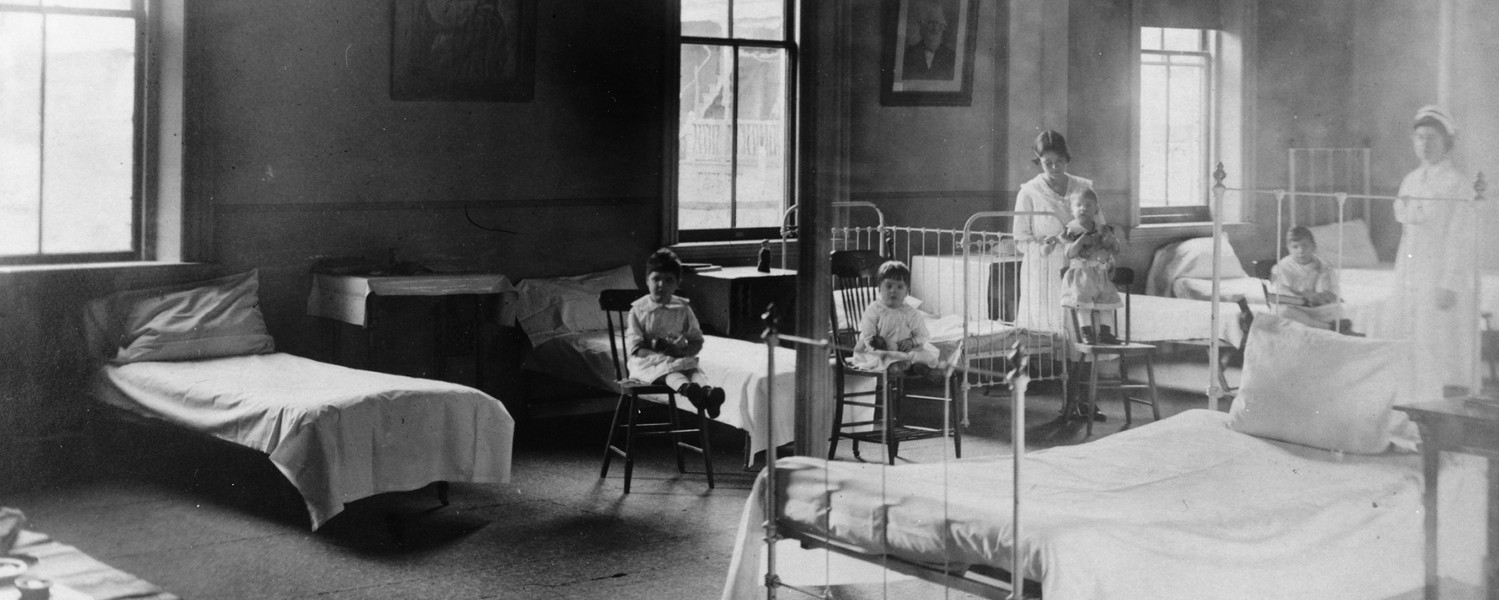
Influenza Epidemic 1918Infirmary for children of flu victims in Burlington's First Church Chapel. Courtesy of First Congregational Church, Burlington.Infirmary in the First Church Chapel, in Burlington, for children whose parents had the flu. Courtesy of First Congregational Church, Burlington.
In the late summer and autumn of 1918, the population of Vermont was ravaged by the pandemic of “Spanish Influenza” that struck nationwide and worldwide. The disease, which attacked the lungs, caused high fever, delirium, excruciating pains in the back and limbs, and nausea, swept across the state rapidly.

Green Mountain Chronicles Radio show

In order to view this object you need Flash Player 9+ support!

Get Adobe Flash player

Powered by RS Web Solutions

Oral history transcriptions

Click a name below for more information. All transcripts are in PDF format.

  • Richard and Georgina Bottamini
  • Susan Sleeper
  • Earnest V. Reynolds

Background information

First noted in reports coming from Fort Devens, Massachusetts, where American troops were assembled for transport to Europe to fight in World War I, the disease quickly spread into Vermont through the transportation centers of St. Johnsbury, St. Albans, White River Junction, Rutland, in the more densely populated communities of Burlington and its neighboring towns, and most severely hit of all, Barre and Montpelier.

The disease typically ran its course in three weeks, but could kill victims in three days or less. Without the aid of antibiotics or antiviral medicines, physicians were unable to treat cases of flu or its complications, most frequently, pneumonia. They were therefore reduced to making diagnoses, treating symptoms, and recording the cause of death. Newspapers carried advertisements for patent medicines, none of which was truly effective in preventing or curing the flu. Makeshift clinics were assembled in churches, libraries, and other buildings. The hospitals in Barre and Montpelier hastily constructed new wings or added a floor to accommodate the flood of patients. In Burlington, the mayor took the unusual and controversial step of opening a dispensary where flu victims with signed notes from their doctors could acquire carefully measured quantities of alcoholic beverages, thought to be a preventative medicine. A critical shortage of doctors, nurses, and medical facilities developed by mid-September, so that Vermont Governor Horace F. Graham turned down the desperate call of Massachusetts Lieutenant Governor Calvin Coolidge for doctors from Vermont. The senior class of medical students at the University of Vermont was pressed into field service; newspapers called on healthy and capable women to take on nursing duties.

By the end of September and into early October, town medical officers began exercising their authority to close all public meeting places—schools, churches, places of entertainment—and a statewide ban on public meetings went into effect on October 4. The Vermont Supreme Court, after postponing its October term several times, finally cancelled it altogether. Middlebury College was quarantined, and the University of Vermont postponed opening its autumn term.

 1918-1919 influenza statistics. Click to enlarge.The flu subsided in November—just as World War I came to an end—but scattered and less severe outbreaks persisted into February 1919. Statistics reported by the Board of Health for 1918 show the devastation. In a state with a population of 355,956 in the 1910 census, there were 43,735 cases of influenza in 1918, resulting in 1,772 deaths. The disease thus attacked 13 percent of the population and accounted for 25 percent of deaths for the year. These were approximate figures only, and do not include cases and deaths from pneumonia.

The epidemic had devastating effects on social and family life in Vermont. Because the Spanish flu had the peculiar pattern of fatally attacking people in the middle years, many children were left with one or no parents and were sent off to live with relatives elsewhere. In hard-hit communities, the deaths came so rapidly, in such great number, and under the stress of quarantine, that funeral ceremonies and interments were frequently performed unattended by mourners.

As a result of the flu a major reform of the public health system was instituted in the 1919 General Assembly. Local Health Officers were abolished and replaced with ten sanitary and health districts. District officers were appointed by the State Board of Health and had to be certified physicians. New regulations and procedures for reporting diseases and issuing quarantine cards were imposed, and other measures were taken to give the state board more control over information about epidemics.

This reform lasted only a few years, however, and in 1923 the town reasserted their local control with a return to the local health officer system, now modified and refined by the memory of epidemic.

—Michael Sherman

For further reading

John M. Barry. The Great Influenza:The Epic Story of the Deadliest Plague in History. (New York:Penguin Books, 2005).

Alfred W. Crosby. America’s Forgotten Pandemic: The Influenza of 1918. (Cambridge [England]; New York:Cambridge University Press, 1989).

Richard Collier. The Plague of the Spanish Lady:The Influenza Pandemic of 1918-1919. (London:Macmillan, 1974).

Dorman B. E. Kent. Diary for 1918. Kent, a resident of Montpelier, Vermont, came down with flu, as did his two sons. He provides an excellent account of symptoms and the impact on the community. Vermont Historical Society library.

Gina Kolata. Flu:The Story of the Great Influenza Pandemic of 1918 and the Search for the Virus that Caused It. (New York:Farrar, Straus and Giroux, 1999).

Howard Phillips and David Killingray, eds. The Spanish Influenza Pandemic of 1918-19:New Perspectives. (London ; New York:Routledge, 2003).

Katherine Anne Porter, “Pale Horse, Pale Rider’ (1938). A short story based on autobiographical material. The author was at the time a reporter in Denver, Colorado, and was stricken with the flu.

Michael Sherman, “‘Awful, Awful’: The Spanish Flu in Vermont, 1918-1919.” Historic Roots: A Magazine of Vermont History Vol. 3, No. 1 (April 1998): 11-18.

Citation for this page

Woodsmoke Productions and Vermont Historical Society, “The 1918 Flu Epidemic,” The Green Mountain Chronicles radio broadcast and background information, original broadcast 1988-89, accessed on the web at http://vermonthistory.org/flu.

  • Leahy Library
  • VHS Library Online Catalog
  • Research Resources Online
    • Sanborn Fire Insurance Maps
    • Green Mountain Chronicles
      • Dewey Day: A Century Ends, 1899/1900
      • The Age of Trolleys, 1901
      • Early Autos in Vermont, 1902
      • Dorothy Canfield Fisher, 1907
      • “Number Please”: The Telephone Comes to Vermont, 1910
      • The Long Trail, 1910
      • Early Aviation, 1910
      • The 4-H in Vermont, 1914
      • Traveling Entertainment: The Chautauquas, 1915
      • World War I: Camp Vail, 1916
      • The 1918 Flu Epidemic, 1918
      • The Co-op Movement, 1919
      • Early Days of Radio, 1920
      • Prohibition, 1920
      • Women Get the Vote, 1920
      • The Anarchist Movement in Barre, 1920
      • Edna Beard: Vermont’s First Woman Legislator, 1921
      • The K.K.K. in Vermont, 1924
      • Walter Hard, Sr.: Vermont’s Storekeeper—Writer, 1924
      • Vermont Country Fairs, 1924
      • Memories of Silent Cal
      • The Flood of ‘27, 1927
      • Vermont in the Great Depression, 1929
      • Collecting Old Songs: Helen Hartness Flanders, 1930
      • Fighting the Depression: The C.C.C., 1933
      • The Green Mountain Parkway, 1933
      • A Symphony is Born: The VSO, 1934
      • The Early Days of Skiing, 1934
      • The WPA, 1935
      • The OWLS: Vermont’s Women Legislators, 1936
      • Fighting Silicosis: Dust Control in the Granite Industry, 1937
      • Robert Frost: Poet Laureate, 1938
      • World War II at Home, 1942
      • Turning on the Lights: Electricity Comes to Rural Vermont, 1943
      • Senator Ralph Flanders, 1946
      • Town Bands, 1946
      • Maple Sugaring, 1947
      • The Case of Alex B. Novikoff, 1953
      • The Coming of the Bulk Tanks, 1954
      • Consuela Northrop Bailey, 1954
      • Hi-Tech Comes to Vermont, 1957
      • Democrats Rising, 1958
      • Dowsing in Danville, 1961
      • Legislative Reapportionment, 1965
      • The Aiken Formula, Myth and Reality, 1966
      • The VT/NY Youth Project, 1968
      • Back to the Land: Communes in Vermont, 1968
      • Act 250, 1970
      • The First Vermonters: The Abenakis, 1976
      • School Consolidation: Farewell to the One-Room Schoolhouse, 1986
      • Railroads, 1989
      • Overview, 1900-1989
    • Manuscript Transcriptions
      • James & Julia Hope Letters
      • Erastus P. Williams Diaries
      • Teddy Roosevelt Re-enactment
    • Civil War Transcriptions
      • Non-Military
      • Martha Johnson
      • Military
      • Charles Buxton Diary
      • William P. Calvert letter
      • Charles Chapin diary
      • George R. Crosby diaries
      • Charles Cummings letters
      • Alonzo C. Farmer letter
      • George Oscar French letters
      • Walter Graham diary
      • Walter Graham letters
      • William Hogan letters
      • Edwin Horton letters
      • George W. Humphrey letter
      • Alfred Horton Keith letters
      • Dan Mason letters
      • George E. Parker letters
      • John W. Phelps requisition
      • William "The Sleeping Sentinel" Scott letters
      • Orlando S. Turner letters
      • Daniel S. White letters
      • William White letters
      • James Willson letters
    • Civil War Research Resources
    • Vermont History Journal
      • Selected Articles, 1921 - 1960
      • Selected Articles, 1961 - 1999
      • Civil War Articles
      • Volume 68 (2000)
      • Volume 69 (2001)
      • Volume 70 (2002)
      • Volume 71 (2003)
      • Volume 72 (2004)
      • Volume 73 (2005)
      • Volume 74 (2006)
      • Volume 75 (2007)
      • Volume 76 (2008)
      • Volume 77 (2009)
      • Volume 78 (2010)
      • Volume 79 (2011)
      • Volume 80 (2012)
  • Ask a Librarian
  • Museum Collections
    • Quilt Collections
      • Gallery 1
      • Gallery 2
      • Gallery 3
      • Gallery 4
      • Gallery 5
      • Gallery 6
      • Gallery 7
      • Gallery 8
      • Gallery 9
    • Faces of Vermont
      • The Chippenhook Family Group
      • The Warren Family
      • Rena Guernsey
      • Daniel Pierce Thompson
      • Lucy Ainsworth Cooke
      • The Whipples
      • Private William Scott
      • William Czar Bradley
    • Rugg Collection
      • Rugg Collection Gallery
  • Genealogy
    • Genealogy Research at the VHS
    • Genealogy Research in VT
    • Genealogy Indexes & Lists
      • Brattleboro Area Irish Naturalizations
      • Lowell Town Records
      • Early Marriages
      • Marriages & Baptisms by Richard Bedford
      • Military Recruiting Photographs
      • Some Vital Records of the 19th Century
      • Washington County Deaths, Funerals, Births & Fires
      • Washington County Selective Service Board
  • Archaeology
  • Vermont Women's History
    • The Deborah Pickman Clifford Legacy Fund
  • Publishing Program
DSC_0543.jpg

Not a member?

Learn how your membership can help preserve Vermont's heritage.

Vermont Historical Society
60 Washington St., Barre, VT 05641
(802) 479-8500

  • directions
  • Career Opportunities
  • contact
  • sitemap

Web site sponsored by: Schultz-Blackwell Trust